
Rear View Mirror – Jake LaMotta
Rear View Mirror – A look back at the career of "Raging Bull" Jake LaMotta
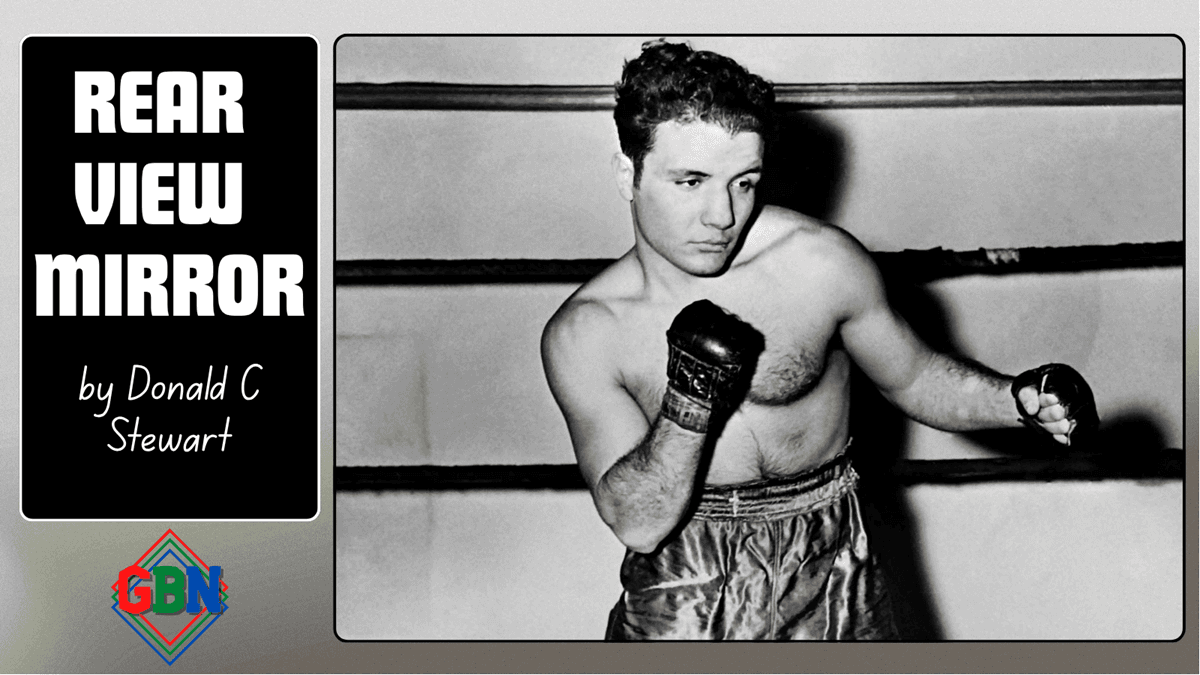
Rear View Mirror – A look back at the career of "Raging Bull" Jake LaMotta
By Donald C Stewart
“Jake LaMotta, 95 years old, is survived by his fiancé” © The Guardian!
As single line obituaries go, there can be few better, but LaMotta was far more than the sum of that sentence. His influence was acknowledged and recognised, such was his reach and the shadow over the sport including its depiction in the cinema. La Motta was a man of his upbringing. He had been in a reformatory in his childhood, married seven times – and not because he liked the taste of wedding cake – admitted to a rape, beating those wives and beating a man to death during a robbery.
In the age of cancellation, he would hardly have had time to get his gloves one before society would have cancelled their unwritten contract with him. He learned to box whilst in that reformatory and the amateur record he had was allegedly a spotless one – no defeats. At 19, he turned over in 1941, spared military service on account of a mastoid operation whilst still child. He was thought to have one of the greatest chins in pugilism. In his interview with the Chicago Sun Times in 1996 he even claimed that, “the punches never hurt me.”
I was a student in Glasgow managing, badly, to fit in a course of film studies when we were asked to watch a black and white effort that apparently had a lot of swearing in it. I was out of love with boxing and getting to see Raging Bull was not, ever, going to make me feel positively about people involved in fighting but then again, it was not meant to make us root for the boxer. Based on “The Bronx Bull’s” autobiography, it was nominated for eight Oscars. Robert De Niro won best actor for his portrayal of LaMotta. LaMotta was so invested that he trained De Niro for a year and that paid off as the boxing sequences that made me wince but then remember why it was that I watched boxing in the first place. The depiction of LaMotta, though we were not supposed to be in his metaphorical corner, made me want to go back and watch it all over again. Its black and whiteness matched La Motta’s memories as he wrote in his biography, "sometimes, at night, when I think back, I feel like I'm looking at an old black-and-white movie of myself.”
That was over 40 years ago, and he would have been a sprightly 65 at the time. His legacy, through that film, his heart rendering and honest biography upon which it is based and a legendary period in the centre of those rings are what make LaMotta, the Bronx Bull, a real-life phenomenon.
Fighters though always need a dance partner and perhaps one of his biggest achievements, was a 6-fight sequence against Sugar Ray Robinson which he lost 5-1 and makes us still think of him as a great boxer.
That legacy survives Raging Bull – if only just.
The film troubled him and when he saw it for the first time, he hated it. Then he realised it was a depiction of how he had been and not how he was now. It catapulted him into the stratosphere and show the world how a fighter, a scrapper, a ducker and a diver survived some of the most brutal of times. With his enlightenment, also came ours and we looked back and saw both the harsh reality of the time and what was needed to survive it – we loved the sinner, hated the sin. His, was a life that gave birth to clichés with surprises tucked round almost every corner.
In his earlier career as a hoodlum, he had once followed local bookie, Harry Gordon home and beat him to take his days takings. Leaving him for dead, the image and the incident haunted LaMotta until that “ghost” turned up in his dressing room after he won the world championship to congratulate him. LaMotta had believed he had killed the man; his presence and the scars he bore from that beating underlined the strange savagery of the man.
So, in 1941, in New York, he made his debut when he beat Charley Mackley on points.in September of the same year, he faced Jimmy Reeves in Ohio and lost a split decision. In a fight which perhaps foreshadowed his entire career, the crowd booed the result for 20 minutes, they played the National Anthem to try and quell the crowd as fist fights broke out and Reeves who was on the canvass for the fourth time in the final round had his arm raised. The referee was clear that, given the lead Reeves had built up, La Motta’s last three rounds were not enough to win. LaMotta was not in favour, but perhaps justifiably so. There was another fight in the 40s with some controversy attached when La Motta stopped Charley Hayes in Michigan. Haye’s manager, Lee Jones claimed it was a low blow that with three seconds remaining in the fight, Hayes was unable to continue – shades of Rico Verhoeven – but Jones seemed to be he only guy who saw this low blow, so his protestations were blown off.
The 6-fight series with Robinson began in 1942 when Robinson beat him on points at Madison Square Gardens, in 1943, in Detroit they met again and LaMotta took Robinson’s unbeaten record, on points.
Three weeks later – that’s 3 weeks – Robinson got his revenge, once more on points before another couple of encounters happened in 1945 with Robinson winning the one in New York by unanimous decision and then a split decision – widely disputed – in Chicago, in the second.
In 1943, La Motta faced Jimmy Reeves again, in Detroit, knocking him out in the 6th round of 10. It was a huge left hand that kept Reeves on the floor whilst actually seen low blows then, in 1944 contributed to LaMotta losing two rounds of the 10 he fought against Fritzie Zivic again in Detroit. Zivic broke his hand in the 1st round but refused to use that as an excuse when he lost on points. Though these fights were not for any titles or belts, they cemented the reputation of LaMotta that he brought fight and stories to his evenings – never in a dull affair, though given the number of wives he had, it appeared that philosophy followed him after the final bell!
Then in 1945, in Illinois, the fifth fight with Sugar Ray Robinson was another 12-round feast for the purist. Robinson, as he had done before was flashy, and could coast whilst the bulldog of LaMotta tenaciously tried to find the way through. In this fight more than the other 4, people were certain Robinson had come a cropper. Claiming it was, “the toughest fight I’ve ever had with LaMotta,” he still had his hand raised, winning by split decision.
The colour if his life was enhanced further in a curious Billy Fox fight in Madison Square Gardens in 1947. LaMotta was unexpectedly stopped in the 4th round, but what marks this out is that, during hearings into organised crime being involved in boxing many years after, LaMotta admitted to having thrown this fight for the mob, but in his autobiography he wrote that only the blind drunk could not have seen it happening, “the first round, a couple of belts to his head, and I see a glassy look coming over his eyes. Jesus Christ, a couple of jabs and he's going to fall down? I began to panic a little. I was supposed to be throwing a fight to this guy, and it looked like I was going to end up holding him on his feet... By [the fourth round], if there was anybody in the Garden who didn't know what was happening, he must have been dead drunk.”
It got LaMotta a world title fight with Frenchman, Marcel Cerdan, in Detroit in 1949, where Cerdan retired and LaMotta claimed the NBA middleweight world crown. Cerdan was forced to retire due to damage sustained in a knockdown during the fight. A rematch was proposed and it was due to happen until tragically Cerdan perished in an aircraft accident.
In 1950, Tiberio Mitri was beaten on points in Madison Square Gardens for the NYSAC world title at middleweight. In the very same year, Laurent Dauthuille was knocked out in Detroit in the 15th round, in The Ring Magazine Fight of the Year with LaMotta winning the world middleweight title. Then in 1951, at the Chicago Stadium, Illinois, the world middleweight title was lost to … Sugar Ray Robinson. Known as boxing’s St. Valentine’s Day Massacre, La Motta was stopped in the 13th taking a beating and whilst in later years he would claim the punches never hurt him, any who saw this fight would thoroughly disagree.
His bravery was stuff of legend but his future less assured.
He continued to fight for 3 more years but he was done. Drink was now his problem and with 106 fights, 83 wins, 30 by way of knockout with 19 losses and 4 draws his contribution to the sport was massive.
In 1954, on the 14th of April at Miami Beach in Florida, LaMotta fought for the very last time. Losing a split decision against Billy Kilgore over 10 rounds was to be his final fight, but far from his eventual legacy.
His retirement included some acting work and some time as a stand-up comedian. His ability to come out with some funny lines were epitomised when he was asked who were the toughest, he faced in the ring. His common response was, ““The three toughest fighters I fought were Sugar Ray Robinson, Sugar Ray Robinson and Sugar Ray Robinson. I fought Sugar so many times, I’m surprised I’m not diabetic.”
Life imitating boxing meant that he was embroiled in many controversies in retirement including when he was arrested for introducing men to underage girls in his club in Miami. Despite such sleaziness he was seen as some kind of hero with his image immortalised with the movie and people eulogising his boxing prowess in ways that were distasteful for some and contextualised what he did, for others.
As a boxer, and as a person, he was a brute. He bullied in the ring, and he continued outside of it. The punishment that he took in his fights did not render him a blubbering mess as his granite ability to take and absorb punishment meant he was seen as a man who was tough to beat; unless of course you had the money.
His standing amongst the media and the public may be defined by a film that is a classic, and though his career never got to the same heights it was equally as distinguished.

More from Global Boxing News
News
O'Shaquie Foster unifies world titles with win over Emanuel Navarrete
O'Shaquie Foster is the No.1 super-featherweight
News
Dalton Smith defended his WBC super-lightweight world title with split-decision victory over Alberto Puello
Dalton Smith and Alberto Puello put on a skilful show
-640x360.png&w=3840&q=75)
News
Albert Ramirez challenges for the vacant WBA light-heavyweight world title against undefeated contender
Albert Ramirez challenges for the vacant WBA Regular light-heavyweight world title
News
Emanuel Navarrete vs O'Shaquie Foster weights, running order, ringwalk times
Emanuel Navarrete vs O'Shaquie Foster schedules, weights, ringwalks