
Book Review: Henry Armstrong, Boxing's super champ
Detailed book review of Henry Armstrong, Boxing's super champ by John Jarrett
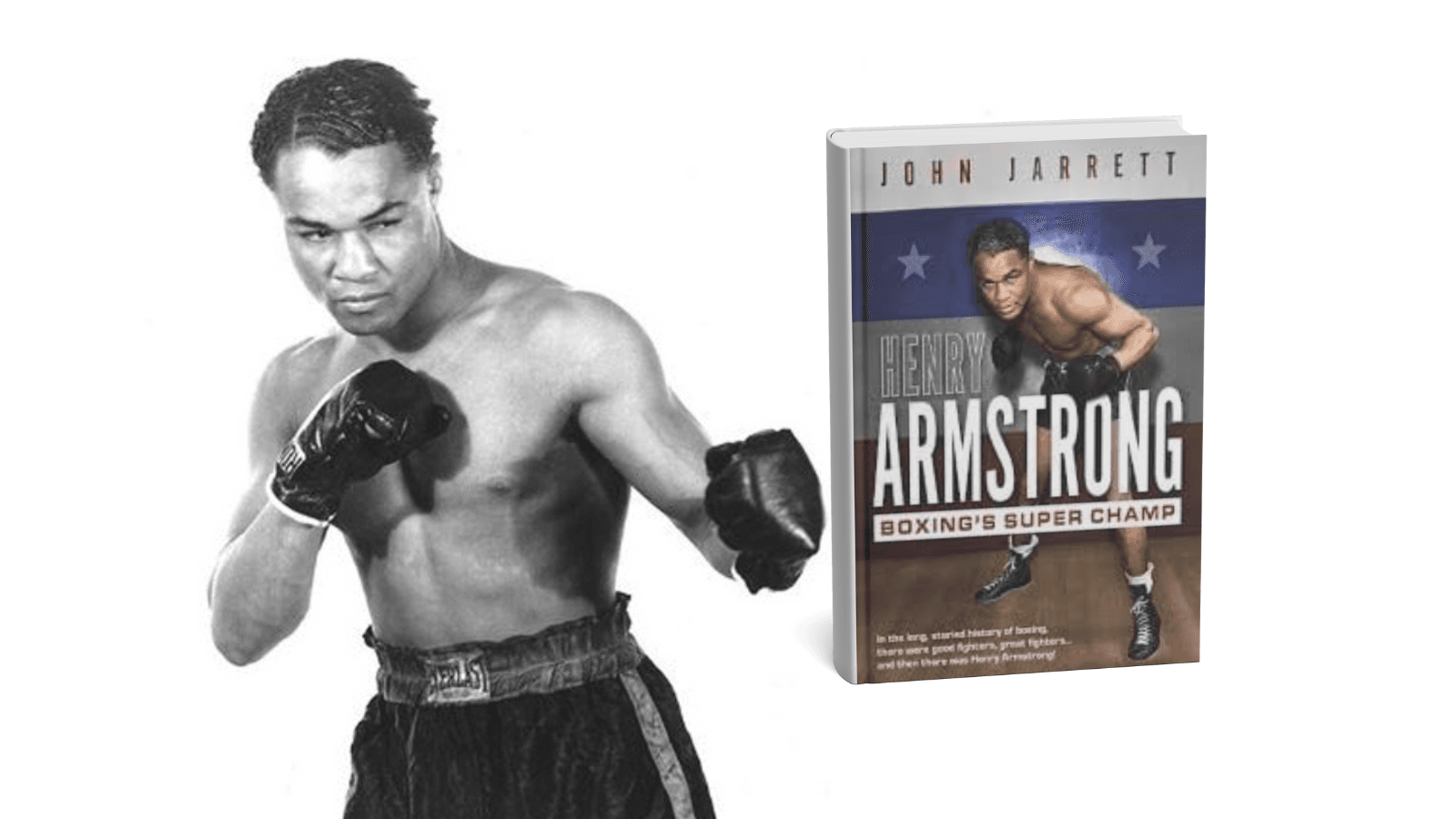
Detailed book review of Henry Armstrong, Boxing's super champ by John Jarrett
Pitch Publishing / Review by Donald C Stewart
Like all names of yesteryear that have gone past the point of personal recollection, Henry Armstrong's name is one that has been lost a little. Superseded by Sugar Ray Robinson, a man who beat him during the war years in the 1940s, Armstrong's name has been lost to us to an extent. John Jarrett does a fine job of resurrecting not only his memory but managing to pull together much of the sports coverage of the time.
The greatest joy of Jarrett's biography is that instead of putting himself up front and centre, giving his views of how Armstrong was seen at the time, he manages to draw together a huge number of sources, giving us not just a flavour of how boxing was seen during the time that Armstrong was boxing, but also allowing us to be immersed in that glorious past. As someone who writes about yesteryear, I appreciate the meticulous research and the handover to those who were there to provide such contemporaneous testimony.
He beautifully tells the tale of how Armstrong had to travel round much of America, from state to state and city to city to find opponents. Armstrong, over his illustrious career managed to be in the square circle a recorded 180 times. He was not, however, a journeyman, having won 149 of those fights with 99 knockouts and was the very first fighter to hold world titles in three weight divisions at the same time. It truly was a different time.
What is a more familiar story is his demise towards the end of his career which, like many other pugilists seems very sad. Ultimately, however 'Hurricane Hank' had one of the most astonishing careers of the time.
Of course, given that the Second World War intervened, meaning foreign opponents were unavailable, becoming the only three-weight world champion at the same time at feather, light and welterweight means that Armstrong's record might be open to scrutiny as perhaps those who would fight in peacetime. But he could only fight the people who were put in front of him and given his incredible record of the time it is hard to believe that the Second World War would be anybody who is likely to within the men's game to at least match his record.
Jarrett's prose does not dwell upon thinking that the past was a long-forgotten country nor presents a familiar form of nostalgia which suggests it was that much better way back then, you feel the struggles people had to get through on the page. We get some incredible gems of detail along the way, including the fact that the man from Mississippi swung a sledgehammer on the Missouri Pacific Railroad at $20 a week, building up his strength much like Jack Dempsey had done in the 19th century; reminding us of how complex world championships were even at this time leaving us perhaps in one way or another envious that it was supposed to be a simpler time - if the New York Commission said that he was the champion he was the champ.
In the 1960s Muhammad Ali was stripped of his world title and had his passport revoked, meaning the U.S. held him to ransom and he was unable to escape their borders to continue his career and defend a world title, because the States held the authority over world titles. There is reference to discrimination around the Hollywood Post's banning, of coloureds fighting in their venue, the Legion Stadium and Armstrong’s role in the Hollywood Post ending its Jim Crow policy; an issue over fighters facing each other with different weighted gloves; and variances in weights; whilst referees notably George Blake did not escape criticism – ‘twas ever thus!
Jarrett includes all of those facts and much more as he builds up the sense that Armstrong himself was, the type of fighter who was going to be hard and difficult to stop in his quest to become a world champion – he truly deserved his ring nickname of Homicide Hank!. Filled not just with the commentary from the fights that Armstrong was in, but also the detail of gate receipts, moneys that were given to Armstrong to fritter away, as well as the crowds, the like of which Carl Froch could only dream about this is a keen read.
Once Armstrong's career began to slide, Jarrett takes a less judgmental tone. It is a measure of the man's longevity in boxing writing that Jarrett manages to not only see the man at the centre of this, but also not to dwell upon his demise. Perhaps others would see it as a fault that by the time we get to hear of the end of Armstrong's career that Jarrett slows down in his analysis. His retiral has less words than the chutzpah of his career.
This is a book which tells the boxing tale and not the over familiar post sporting freefall. It makes this a book well-worthy of those book vouchers that you got for Christmas.
Henry Armstrong was a remarkable pugilist, an incredible fighter, and someone who drew remarkable crowds across the whole of America in a time when darkness descended upon the world. He was one of the very best boxers of the twentieth century and Jarrett does him and us a great service in chronicling him throughout that career.
Buy from Amazon
DID YOU KNOW? Henry Armstrong and Terence Crawford are the only boxers in history to hold undisputed championships in three different weight classes

More from Global Boxing News
News
O'Shaquie Foster unifies world titles with win over Emanuel Navarrete
O'Shaquie Foster is the No.1 super-featherweight

News
Dalton Smith defended his WBC super-lightweight world title with split-decision victory over Alberto Puello
Dalton Smith and Alberto Puello put on a skilful show
-640x360.png&w=3840&q=75)
News
Albert Ramirez challenges for the vacant WBA light-heavyweight world title against undefeated contender
Albert Ramirez challenges for the vacant WBA Regular light-heavyweight world title
News
Emanuel Navarrete vs O'Shaquie Foster weights, running order, ringwalk times
Emanuel Navarrete vs O'Shaquie Foster schedules, weights, ringwalks