
Balraj Khara: The British boxer with a superpower
Exclusive interview with Balraj Khara
-1.png&w=3840&q=75)
Donald C Stewart exclusive interview with British Sikh boxer Balraj Khara
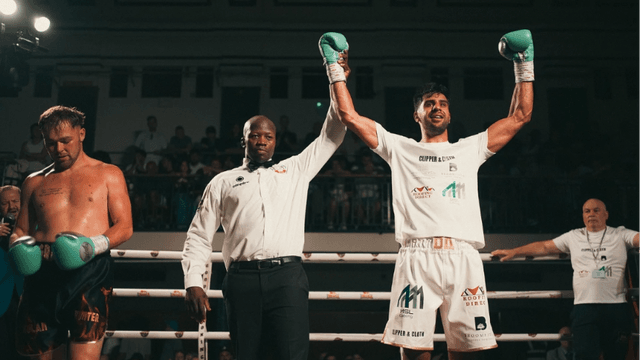
British boxer Balraj Khara (9-2-2, 1 KO) returns to the ring on September 19, against experienced Costa Rican fighter Jose Aguirre (2-28, 1 KO) at Harrow Leisure Centre, London.
A veteran of over 30 contests, Aguirre is a valuable test for Khara, especially after an extended time out of the ring.
Khara came to the pros in 2022, after a successful amateur career and is now training at the Ivybridge Boxing Club in Isleworth under head coach John Holland.
As well as being a professional boxer, the Feltham fighter works with the charity Rise and Thrive, helping raise awareness of child exploitation and encouraging young people to overcome challenges and realise their potential.
A third-generation British Sikh, he is keen to increase South Asian representation within professional boxing and provide inspiration for the new generation of athletes from diverse backgrounds.
But that’s not the most surprising thing about him.
To be fair, if that was all that marked him out as exceptional, then that would be more than enough to catch your attention.
But Khara was born with a hearing impairment: he calls it his superpower.
I got the opportunity to catch him and find out why it is the difference that makes him the true focus for the future of the super middleweight division in the UK. We began with when he started in quite the variety of sports. “I started karate when in primary school, then went to play football, (and) didn't pick up kickboxing until I was about 15, 16. I didn't have my first amateur boxing fight until I was about 20, 21.”
Coming to the sport late is not unusual, and for such a sporty kid, there is an obvious range of disciplinary experiences, but Khara was drawn to boxing. “I've always enjoyed boxing, (and) when you really want to try something, you just have to.” He was not, however, aware of quite what he was walking into, “I think that was a good thing, because I had no clue, I had no expectations. I just enjoyed training; I enjoyed the spar.”
That enjoyment led to his amateur career, something which he feels really set him up, though initially he was unaware of what to expect. “I never knew anything about the amateurs. Didn't know something called the amateurs existed. I was that oblivious to it. I was just training!” So, when one day, one of the coaches raised it, Khara was enthusiastically in, soon becoming a keen student, “when I started doing a bit of research.” Following the mantra in the professionals of always staying in shape, Khara “kept fit, in shape, on weight.” Then would come, “a phone call, ‘I can get you a fight tomorrow do you want it?’ I'm like sure 100%!” His trainer was clearly keen to keep him active.
Some opportunities, however, weren’t always welcome. ”I remember I had a fight, then planned to go out and watch an AJ fight. I thought, I fought Saturday, (so) had Sunday off training. As I stepped out of the ring he goes, I've got you a fight next weekend. I need you in the gym tomorrow morning! It just literally was like that, just keep yourself ready. He was a great matchmaker, getting fights.”
It led to an amateur career where Khara had, “about 30 odd fights and won about 23, 24 of them.” In that career, Khara, “got the opportunity to represent London in Jersey and Germany, during the Munich Beer Festival which was great! I won the London Developments, boxed in the Haringey (Cup) so yeah, I had a great experience.”
It was great experience for turning pro in more ways than one, as Khara explained, “you have no clue where it can take you. I had my first amateur fight in Chichester, and I've been to Birmingham, Ipswich, I think Devon, Cornwall, Kent, the home counties. You never know where you're going to end up.”
One destination he knew it would end up was with a professional contract which came around, when Khara, “was getting to the age of entering the elites.” Things then came to a stuttering halt – COVID.
“Everything started getting cancelled, everyone going into lockdown, and we didn't know how long this was going to last. I was about 25, 26 at the time, (and) we needed a decision. I thought, what's the worst that could happen – let's just go for it. And here I am!”
Having weathered that storm, Khara was handed the opportunity to fight for a Southern Area belt at light heavyweight – a natural super middleweight, it was an opportunity too good to turn down but it led a loss. “No discredit to the opponent, but I was never really a true light heavyweight. After that fight, I went down to super middleweight. My next fight will be at super middleweight, and I will be contesting for titles at super middleweight.”
He will also be competing as a boxer who is deaf. Khara’s hearing is, “60% deaf on my left, and on my right, I am around 40 to 50%.” It is a significant loss which adds to his preparations and contact with the British Boxing Board of Control (BBB of C) “The board know that I wear hearing aids, (and) I do my hearing test each year to make sure it's all fine. Obviously, you need to be able to hear the bell and hear the referee. I can hear that. Apart from that, you're in the boxing ring all alone.” Referees are sensitive and don’t make concessions as Khara explained further, “they definitely double check when I enter the ring, make sure that I haven't got my hearing aids in, make sure I understand the commands – my coach will just reaffirm them as I get into the ring just to make sure.” Aside from that referees have just got to be, “speaking louder and clearer.”
It also means he needs to, “concentrate more. I need to be more focused because my hearing lets me down. I'm not able to hear certain calls or plays etc stuff like that. It means that I have to focus more on what's in front of me and I can't switch off. I always have to be locked in to know what I'm doing. When I'm in the ring or in the gym, I'm using my eyes to see what is going on, scan in the room, just to bring me like anybody else.”
It’s not all plain sailing as Khara explained, “it's a double-edged sword because, at the same time not being able to hear everything going on. It just means that I can focus, but also at the same time, I need to hear certain things that are being said in the corner. I won't go into too much detail and give away too much, but something me and my coach have worked on, developed, practiced and trialled – it's coming together now.” Intrigued, I was about to ask what it was they had developed to be told he, “can’t give away too much of the tricks of the trade, but we've found something and it works. He (his coach) does something different in the corner to make sure I understand. What's really helped is the way that he speaks. His voice is very assertive, very clear. Of course, I'm pretty sure every coach is like that, but boxers are always doing something wrong, aren't they? I get used to when I finish a round I go sit down I don't even think like oh yeah great round this and that I just think right here we go what's he going to tell me off now I just go right okay but then when he goes to me oh you've done that really well I go what, did I hear that right?”
We turned then to the day and daily issues which are faced by many in the d/Deaf community. Khara is not completely deaf but having to constantly work on something we do without thinking can be, “exhausting, mentally draining. If you hear something, you're really trying to focus, it takes it out of you. I lock in on something and then just use my visuals to help me. Subconsciously we have to be a bit more locked in.”
I was conscious throughout our chat to look directly into the camera, aware that rather than exaggerating my words I needed to be square on – so Khara can see my lips as he explained, “people need to be face-to-face so we're able to lip-read. It makes such a big difference. When they turn their head or they're talking to someone else and you're like, oh, I can't lip-read. I really can't hear what you're saying.”
Environment plays such a big part too and I was surprised by which places provide Khara with the greatest challenges. “In a loud environment, everyone talks a bit louder, a bit more deep with their voice. I can understand that. What I really struggle with is that when it's very people with a soft tone of voice, at a dinner table talking or at breakfast time in the morning, when everyone's a bit more chilled, very soft-spoken – that's where I really struggle. I've been at dinner tables just eating my food and someone said something and I've just continued eating and someone just looks at me and goes you're not gonna answer and I'm like oh sorry did you say something?”
One of the boxing advantages, of course is he never hears the boos! “No, you're right there. When I can't hear, there's no point trying to hear – just focus on the task at hand and just get on with it.”
One of boxing’s disadvantages is time out of the ring, something that Khara is seeking to put right on the 19th. “I've been a year out.” The focus is therefore to, “just get this fight over and done with, then we're going to be pushing on for titles. We want to get on the big shows, get either a Commonwealth title or Southern Area, anything like that. I want to push on and test myself.”
Understandably though Khara’s focus is on the 19th and not who he would want next, “At my level, I want the person who's got the biggest name. I want the person who people look at and go, he's one to look out for. Those are the people I want. I want to spoil the party. I want to be that guy that's upset the apple cart.”
As for his deafness, Khara has grown from shying away from it as a topic to realising it that it is a unique weapon and one he wants to use for good. “This is who I am. This is my makeup. This is my DNA, and I'm not going anywhere at all. I want to show people, that anything is possible. I never wanted to play the victim card. I just wanted to be treated normally and then just get on with it, but then as I was speaking to more people, I've become more open about talking about it. I've never wanted it to be ‘oh he's only there because of his disability.’ I want to be there because of my boxing skill, but the disability is a part of it. I feel it's important for me to have these conversations with people and just shed light on it, but I want people to look and go, he's got a disability he's able to do these things. I want to inspire those people to go and achieve in what they want to do. I want to be a boxer and then people go oh you know he's also deaf as well not the other way around.”
Khara goes into the ring on the 19th with the avowed aim of making sure his career in the ring is back round the right way again.

More from Global Boxing News
Features
Rising British super-middleweight star Balraj Khara calls hearing impairment his "superpower"
Boxing's rising star Balraj Khara has a superpower – his hearing impairment
News
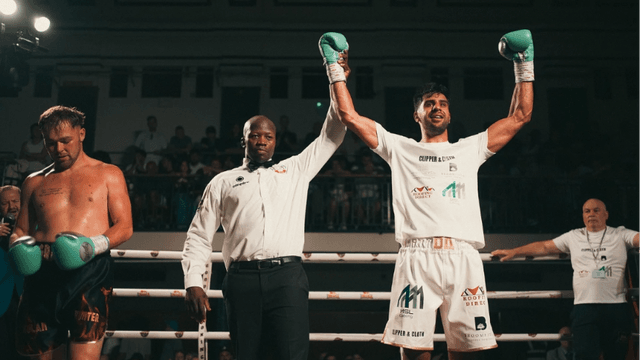
Hearing impaired Sikh boxer announces next fight on September 19
Super-middleweight returns to the ring in major Harrow showdown
Features
Amir Khan issues backing for professional debutant to become first ever Sikh world champion
Amir Khan will advise Tal Singh ahead of summer debut