
Rear View Mirror: Willie “The Worm” Munroe
Willie “The Worm” Munroe conquered Marvin Hagler during his 51-fight career
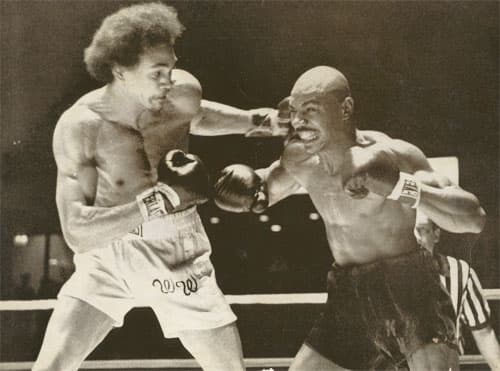
A look back at the career of Marvin Hagler rival, Willie “The Worm” Munroe
GBN's Caledonian columnist Donald C Stewart takes a look into his rear view mirror at the 51-fight career of Willie the Worm, the man who defeated Marvin Hagler before he embarked on an 11-year unbeaten streak
22nd June 2019 saw the passing of the Willie “The Worm” Monroe )39-10-1, 26 KOs).
Monroe was one of the men on whose shoulders the legend of the Philly fighters was built. He came into the professional game with an unbeaten amateur record which is believed to have been 43 fights, 43 wins, 37 by way of knockout – or at least that is what we think! Amateur records can be notoriously difficult to verify, though legendary status demands mythology as part of its make up.
Writing in Boxing Scene just after his passing in a tribute to Monroe, his promoter, Russell J Peltz, described the first time he saw Willie Monro. “Yank Durham brought him to Champs Gym in the fall of 1969. Joe Frazier’s Gym on North Broad Street was not yet built. Champs then was located a few yards from where Columbia Avenue (now Cecil B. Moore) turns into Ridge Avenue in North Philly. It was a second-floor walk up over the aptly named Roach’s Café. … Roland Marshall, a North Philly middleweight who was having his own way sparring with most guys, went a few rounds with Willie. It was an eye-opener. Willie was all over Marshall, who didn’t have the strength to use any kind of leverage.”
Monroe was from a huge family he was one of sixteen. Willie caught the fighting bug watching sports on the TV when his family moved to Rochester in New York. His initial work at the gym, Monroe bewitched with a style some compared to Cassius Clay, because as was mentioned in his obituary in Boxing News, “Monroe leant out of danger before pouncing with punches from both sides.
When he was 19, he found himself in Philadelphia and Gypsy Joe Harris introduced him to trainer, Yank Durham who gave him his nickname when he said, “Why just look at that boy out there, he’s actin’ just like a worm.”
His amateur career, if Monroe is to be believed should have led to representing his country, there are reports that illness kept him out of the 1968 Olympic Games.
November 11th, 1969, was when he turned from an amateur demigod into a professional fighter. Vince Neratka obliged by being in the opposite corner and Monroe won by TKO in one round at he Blue Horizon in Philadelphia. Nobody noticed much as he turned over without much of a murmur. He had to hold onto his day job – as a truck driver with Clarkie’s Inc.
The Boxing News obituary quoted, he 1971 report in Boxing Illustrated, by Jack Obermayer who described Monroe’s style “He has the physical attributes to mould himself into a great fighter. At six feet even, he is tall for his 158 lbs, and he uses his long reach advantage that he uses to the fullest. He has blinding speed of both hand and foot and when he stops to punch, he does more than just sting, he bangs.”
Monroe was being noticed, not least because he was a stable mate of a certain Joe Frazier which meant he got to fight on his undercards though that does bring its own pressures. Frazier fights were never ignored, deflected glory was a nice side effect. Monroe though was clearly the real deal.
Twelve more fights followed, and Monroe knocked each one of them out, then he went the distance with Alvin Phillips on Frazier’s undercard when he defended against Terry Daniels in New Orleans. It was the eve before 1972 Super Bowl.
But 72 was to bring the first blip on his career. Inexplicably, Monroe went abroad which for those of us outside of the United States is quite a normal thing but given the size of the States and the level that boxing had gotten to within that country, is unusual at the early stage of an American boxer’s career.
He went to Paris, but unfortunately, travelling did not agree with him and he lost, albeit by split decision to Max Cohen at the Palais des Sports Porte de Versailles in Paris. In November, a year later, he was back in Paris and drew on points against Fabio Bettini. No wonder so few Americans have a passport!
His career soon picked back up again and by 9th of March 1976 he was to be found standing in the ring, in The Spectrum in his hometown of Philadelphia, opposite the marvel that was Marvelous Marvin Hagler. It’s a fight for the memory as there is no video of it; the crew, due to film it was unable to get to the stadium due to a snowstorm!
According to those who were there, it was pure war and the unbelievable happened – Monroe got the nod and beat Hagler on points. Hagler may have got his revenge, not once but twice in their trilogy and these are available to view, but the fact remains, that in one of the biggest fights of his career, his biggest win, is a contest that people can talk about, argue over but find no way of proving or disproving their mythologies because it aint available to view anywhere. Aint that great!
Peltz, his promoter certainly thought so, “That was the night he became, in my opinion, the only man ever to decisively whip Marvelous Marvin Hagler. It was Willie’s greatest night ... More than 3,000 diehard fans took the subway to get there and they witnessed a classic. Willie stood in there and went punch-for-punch with Marvin. Every round was a war, but Willie won at least seven of them. Hagler, who had been the victim, in most everybody’s opinion, of a bad decision two months earlier against Boogaloo Watts in the same ring, could not understand how Willie could have lost to Watts (he did, late in 1974) but be so much better 17 months later. “I’ve got a lot to learn” Hagler said after losing to Monroe”
United Press reported it thus: “In the second round, Hagler suffered a nosebleed from a short left hook and a straight right hand. In the fifth, Monroe came out with three consecutive uppercuts and Hagler lost his mouthpiece and his nose started to bleed profusely. Hagler tried desperately to battle back and returned with a series of body punches. Monroe picked his opponent apart in the seventh with the jabs and the nose continued to bleed… In the 10th, Monroe took command and put too much pressure on Hagler.”
Hagler fought Monroe twice again, both in 1977. In February of that year in Boston, he stopped Monroe, in the 12th of 12 and then back in The Spectrum in August, he stopped him again, this time in the second round. It took another 11 years and a certain Sugar Ray Leonard to beat Hagler again…
Those defeats to Hagler in the rematches meant that Monroe never got into a ring for a world title again.
Once the lights dimmed in his career, in his final 10 fights saw a shadow of a fighter emerge as Willie Monroe, and he lost 6 of the last 10. One of his final fights though was when as a 30-year-old he faced a 20-year-old Philly new boy, Curtis Parker. Monroe went toe to toe to take the young boy the distance but time and the wars he had been in was calling time on his career. By now people could see what he could have been, had the confidence he had in that fight with Parker had been the confidence he had shown in many of his previous ones.
He fought three more times, after the Parker fight losing two of them and when future IBF light heavyweight contender Willie Edwards knocked him out in the 4th round, Monroe knocked his professional career on the head too.
It was 1981 and time to retire.
Once retired he did stay in the game for a little while, as a referee, but his heart was clearly not in it and he retired from that. According to is promoter, Peltz, “he refereed like he boxed, sometimes unsure of himself. I’m not convinced Willie ever had the confidence to match his ability as a fighter. He had good size, good range, boxing ability and power. At times, I believe he doubted his own skills. It’s hard to tell how far he could have gone with just a little more self-confidence. Yet on two of his greatest nights, he fought tough. One was the win over Hagler in their first fight. The second was his heroic late-career stand against Parker.”
Like so many boxers who we watch from a distance, Monroe was long in our memories and someone we took to heart. The first night against Hagler is one that has folklore written all over it and it’s with deep regret that only those who were there can genuinely talk about it, but we talk warmly of many boxers of yore, Willie “The Worm” Monroe is another of whom memories are made and sweet they are too.
Now he sits as the uncle of Willie Monroe Jr. who upon hearing that his uncle had passed, vowed to win a world title in his honour. Twice he climbed into the ring to take on the challenge, Gennady Golovkin and Billy Joe Saunders retained their belts, the IBO and WBA for Golovkin, the WBO for Saunders.

More from Global Boxing News
News
Two unbeaten Mexican stars set to steal the show on Pitbull-Bravo card
Blancas and Verde perform on Pitbull undercard
-1-640x360.png&w=3840&q=75)